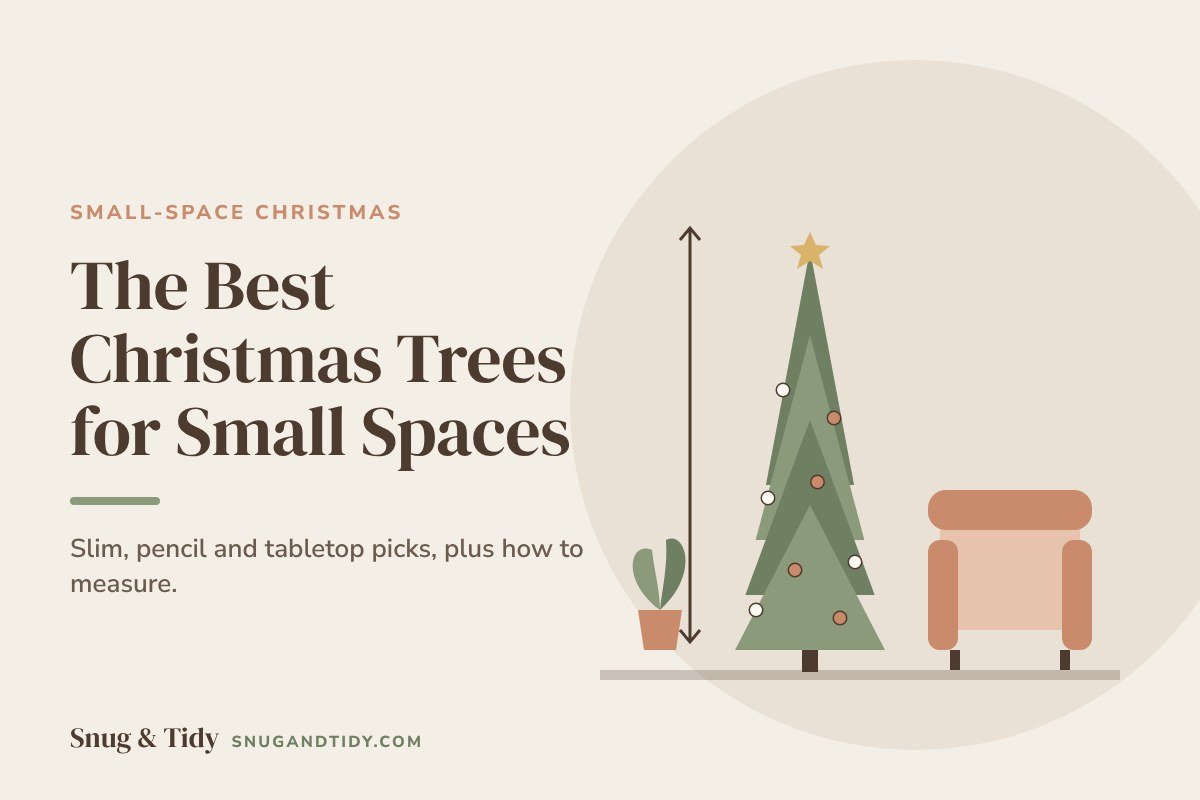
The Best Christmas Trees for Small Spaces (Slim, Pencil and Tabletop Picks by Budget)
This post contains affiliate links, including Amazon. As an Amazon Associate we earn from qualifying purchases, at no extra cost to you. Disclosures.
The best Christmas tree for small spaces is usually a pencil tree for tight gaps and narrow rooms, a slim tree for a small living room corner, a half or flat-back tree when depth is the problem, and a tabletop tree when there is no floor space at all. The right one depends on three numbers you can measure in five minutes: your ceiling height, the floor spot you can spare, and the walkway you need to keep open.
Below: a size table for each tree shape, a simple measuring method, what to check on the box, picks by type and budget, and safety for real and artificial trees in tight rooms.
Quick answerFor most small rooms, choose a pre-lit pencil tree about 6 to 6.5 ft tall with warm white LED lights. Pencil trees are often around 19 to 28 inches across, so they fit a spot about 2 to 2.5 ft wide. Pick your height this way:
- Max tree height = ceiling height minus your topper (about 6 in) minus at least 6 in of gap.
- 8 ft ceiling: a 7 ft tree is the max; 6.5 ft looks more relaxed.
- No floor space: a 2 to 4 ft tabletop tree or a half tree against the wall.
- Keep about 36 in of clear walkway and at least 3 ft between the tree and any heat source.
In this post
1. Small-space tree shapes compared
“Small” can mean a short ceiling, a narrow floor or a shallow wall. Each shape solves a different one. Widths below are typical figures from retailer size guides and listings; always check the listed base diameter of the exact tree.
| Tree type | Typical diameter at the base | Floor spot needed (diameter + 3 in) | Best for |
|---|---|---|---|
| Pencil | Most are about 19 to 23 in; some 6.5 ft models reach 28 in, and very tall ones up to about 35 in | About 22 to 31 in | Studios, narrow gaps beside a sofa or bookcase, entryways, small bedrooms |
| Slim | Wider than pencil, narrower than full; one 7.5 ft slim example measures 43 in | About 46 in on a 7.5 ft tree | The corner of a small living room where you want a fuller look |
| Full (for comparison) | About 4 to 5.5 ft (48 to 66 in) | About 51 to 69 in | Open-plan rooms; usually too big for an apartment |
| Half or flat-back | Full-width front, flat back, so it sticks out from the wall about half as far as a round tree of the same width | Width x roughly half the width in depth | Shallow spots against a wall, behind a door swing, hallways |
| Corner | Usually a half tree or a pencil tree tucked into the angle; measure the diagonal, not just one wall | Check both walls plus the front edge | Dead corners in small living rooms and bedrooms |
| Tabletop | Small trees are often 2 to 3 ft for accents; 4 to 4.5 ft trees are typically meant for tabletops | Zero floor space; needs a sturdy table or console | Studios, dorms, bedrooms, kitchens, very small apartments |
Diameter is measured at the widest point, which is the bottom tier of branches. A tree that fits at floor level almost always fits higher up, so the base number is the one that matters.
2. How to measure your space (step by step)
Three mistakes cause most bad fits: a topper that hits the ceiling, a base that blocks a walkway, or a tree too wide for its corner. This method covers all three.
Step 1: Ceiling height minus topper minus gap
Measure from the floor to the ceiling at the exact spot. Retailer size guides suggest leaving 6 to 12 in between the treetop and the ceiling, and note that toppers tend to be about 6 in tall. Some sellers suggest as much as 18 in of space. Also check whether the listed tree height includes the stand; if it does not, add the stand height.
| Ceiling height | Max tree height (6 in topper + 6 in gap) | Relaxed pick (6 in topper + 12 in gap) |
|---|---|---|
| 7 ft (84 in) | 6 ft | 5.5 ft |
| 7.5 ft (90 in) | 6.5 ft | 6 ft |
| 8 ft (96 in) | 7 ft | 6.5 ft |
| 9 ft (108 in) | 8 ft | 7.5 ft |
The math: an 8 ft ceiling is 96 in. Minus a 6 in topper and a 6 in gap leaves 84 in, a 7 ft tree. In a small room the relaxed column usually looks better.
Step 2: Floor diameter
Measure the width of the spot you can spare, wall to furniture edge. Size guides suggest about 3 in between the tree base and the wall, so the tree’s listed diameter plus 3 in should be equal to or less than your measurement. Example: a 23 in pencil tree needs a spot about 26 in wide.
Step 3: Walkway clearance
Now measure from the front edge of the tree spot to the nearest piece of furniture. The US accessibility guideline for a clear route is a minimum 36 in wide, and it is a good everyday benchmark for a main path through a room. If placing the tree leaves less than about 36 in where people walk, choose a narrower tree or a different spot. Never let the tree block a door or exit.
Step 4: Tape it out
Mark the base size on the floor with painter’s tape and live with it for a day. If you trip over it, hit it with a door or cover a vent, choose again before you spend anything.
Free: the 30-Day Declutter Challenge
15 minutes a day, one small space at a time. Get the 24-page printable (calendar, room checklists, tracker) plus a short daily tip by email.
3. Best picks by type and budget
These are product types, not brands, so you can compare options in your budget. Budget picks are unlit or tabletop trees, mid picks are pre-lit pencil trees, and splurge picks add height, hinged branches and realistic PE tips.
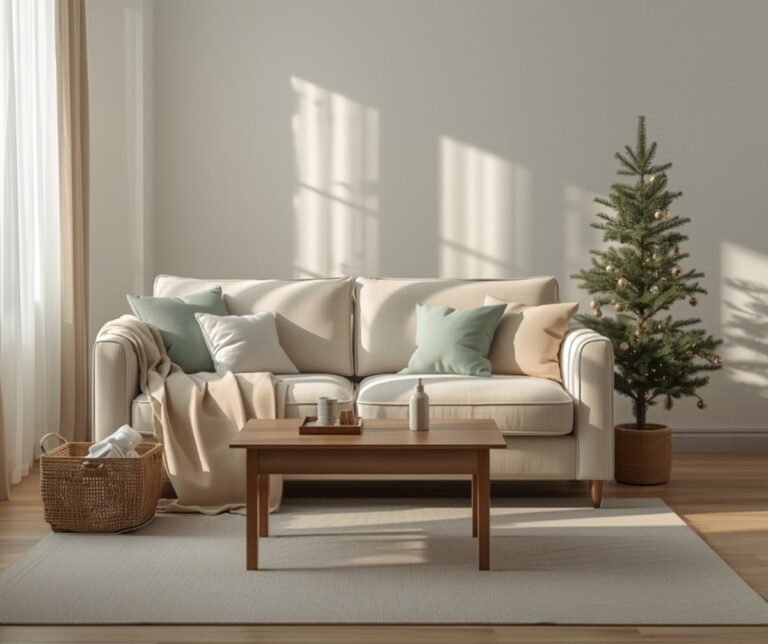
6 to 6.5 ft pre-lit pencil tree with warm white LED lights
The easiest win for 7.5 to 8 ft ceilings and tight floor plans. Look for a listed base diameter under about 28 in, warm white LEDs, hinged branches, and a UL, ETL or CSA mark on the lights. A foot switch or a plug that works with an outlet timer saves crawling behind the tree.
Shop on AmazonUnlit 6 ft pencil tree with hinged branches
Unlit trees usually cost less and let you choose your own lights, which also means one dead section never ruins the whole tree. Check the base diameter, the number of sections (two or three is easier to store), and whether the stand is metal rather than thin plastic.
Shop on Amazon7 to 7.5 ft pre-lit slim tree with PE tips
For 8.5 to 9 ft ceilings and a living room corner of about 4 ft. Molded PE tips look more like real needles than flat PVC tips. Compare tip counts between trees of the same height, and confirm the listed diameter fits your taped spot before you order.
Shop on AmazonHalf or flat-back Christmas tree
A half tree looks full from the front and sits flat against the wall, so it gives back depth in a hallway or a narrow living room. Check the depth measurement (wall to front tip), not just the width, and make sure the flat back has a stable stand or wall-safe support.
Shop on Amazon2 to 3 ft pre-lit tabletop tree with a timer
The low-cost answer for studios, bedrooms and kitchens. Battery or USB power means no cord across the room; a built-in timer saves batteries. Look for a weighted or wide base so it does not tip on a console table.
Shop on AmazonLive potted tabletop tree
If you want a real tree without a big cut tree in a small room, a small potted tree is the gentle option. Check the pot size against your table, use a saucer to protect the surface, and follow the plant’s care tag for light and watering.
Shop on AmazonWarm white LED mini lights with a safety mark
Choose warm white (around 2700K, often sold as soft or warm white), green wire to hide in the branches, and a UL, ETL or CSA mark on the package. Follow the maximum connected strings printed on the box.
Shop on AmazonTree collar instead of a tree skirt
A wide skirt spreads well past the stand and eats into the walkway. A collar hugs the stand and keeps the base tidy, which helps in a tight walkway. Measure the stand width and pick a collar a few inches wider.
Shop on AmazonIndoor plug-in outlet timer
Lights should be off when you leave or go to bed. A simple timer handles that, and it saves reaching behind a tree wedged into a corner. Check the timer’s rated load against your lights.
Shop on AmazonSmall Apartment Christmas Decor Ideas: 21 Space-Saving, Renter-Friendly Ideas
4. Pre-lit vs unlit, and why warm white LED
Pre-lit trees set up faster with lights already spread evenly, which helps when the tree is tucked into a corner. The downside: a failed section can be fiddly to fix.
Unlit trees usually cost less up front and give you full control. A common rule of thumb is about 100 lights for every 1.5 ft of tree. For a 6 ft tree that is 6 divided by 1.5, times 100, or about 400 lights; for 6.5 ft it is about 435. Go up for a glowy look, down for a soft one.
Why LED: LED strings use far less electricity than incandescent strings and run much cooler, which lowers the risk of fire and burns. That cooler running matters in a small room where the tree sits close to curtains, a sofa or a bookcase.
Why warm white: cool white LEDs can read blue and harsh in a small room at night. Look for warm or soft white, which lighting charts list around 2700K, to match lamps and keep the space cozy.
Check every light string (or the pre-lit tree box) for a mark from a testing lab such as UL, ETL or CSA, confirm it is rated for indoor use, and never connect more strings than the package allows.
5. Tip counts and how to fluff a small tree
Tip count is the number of branch tips. It is only useful when comparing trees of the same height and shape: a 6.5 ft pencil tree with more tips looks fuller than one with fewer.
Tip material matters too. PVC tips are flat, needle-like strips; PE tips are molded to look like real needles and generally look more lifelike. Many mid and splurge trees mix the two, with PE on the outside and PVC filling the inside.
How to fluff an artificial tree, step by step
- Put on garden gloves; tips can scratch.
- Start with the bottom section only, before stacking the others, so you can reach the inner branches.
- Work from the trunk outward. On each branch, separate the tips: one up, one left, one right, in a loose fan.
- Bend the branch ends slightly upward so ornaments do not slide off.
- Stack the next section and repeat. Fluff the top last. Against a wall, fluff the back lightly.
- Step back a few paces and squint. Fill obvious gaps by pulling inner tips forward.
6. Storage size: check it before you buy
In a small home, the tree has to live somewhere for eleven months. Before you order, check these on the listing:
- Shipping box dimensions. This is roughly how much closet or under-bed space the tree needs. Compare it against your closet depth and shelf height.
- Number of sections. More sections mean shorter pieces that fit smaller spaces; fewer sections mean faster setup.
- Hinged vs hook-on branches. Hinged branches fold up against the trunk for storage. Hook-on branches come off one by one and take longer.
- Original box vs bag. Boxes tear after a few seasons. An upright storage bag with wheels can hold a slim tree standing, with branches folded, and slide into a closet corner.
Upright tree storage bag with wheels
Check that the bag’s height and diameter match your tree (many are sized for slim trees), that it has a sturdy zipper, and that it fits standing in your closet with the door closed.
Shop on Amazon7. Real vs artificial in a small space, plus safety
Artificial wins in most small homes: you can buy the exact width you measured, there are no needles to sweep, and slim and pencil shapes are easy to find. Look for a “fire resistant” label.
Real trees bring scent and are worth it if you have the spot and the routine. In a small room, choose a shorter, narrow tree or a potted tabletop tree, then follow the basics:
- Pick a tree with fresh, green needles that do not fall off when touched.
- Cut about 2 in from the base of the trunk before putting it in the stand.
- Add water to the stand daily. A fresh tree drinks a lot on the first day.
- Remove it after the holidays or as soon as it dries out; do not store a dried tree in the home or garage.
Safety rules for any tree in a tight room
The National Fire Protection Association (NFPA) notes that Christmas tree fires are not common, but when they happen they are more likely to be serious. In about one in four home Christmas tree fires, a heat source was too close to the tree. Its guidance:
- Keep the tree at least 3 ft from any heat source: fireplaces, radiators, candles, heat vents and lights.
- Make sure the tree does not block an exit.
- Use lights listed by a qualified testing laboratory, and check whether they are for indoor or outdoor use.
- Replace strings with worn or broken cords or loose bulb connections.
- Follow the manufacturer’s limit on how many strands to connect.
- Never use lit candles on a tree, and turn tree lights off before leaving home or going to bed.
Use flameless candles anywhere near the tree or greenery. In a small room, a real candle is rarely 3 ft from something that can burn.
8. What to skip in a small room
- Full-profile trees. At about 4 to 5.5 ft wide, they can take over a small living room.
- Big tree skirts. Use a collar or a basket instead.
- Cords across walkways. Place the tree near an outlet, or use a battery tabletop tree.
- Heavy flocking in a tiny home. Flocked trees can shed white bits, which shows up fast on small floors.
- Spots in front of radiators, vents or space heaters. The 3 ft rule rules them out.
9. Small-space tree checklist
Before you buy a tree for a small space
- Measured ceiling height at the exact spot
- Subtracted topper height and at least 6 in of gap
- Checked whether listed height includes the stand
- Measured floor width; listed diameter plus 3 in fits
- About 36 in of walkway left clear in front
- At least 3 ft from radiators, vents, heaters and fireplaces
- Tree does not block a door or exit
- Lights have a UL, ETL or CSA mark and are rated for indoor use
- Warm white LED chosen; outlet timer ready
- Storage box or bag fits your closet
- Real tree: trunk recut, stand watered daily
- Artificial tree: “fire resistant” label checked
FAQ
What is the difference between a slim and a pencil Christmas tree?
A slim tree is a standard cone shape with a narrower base, while a pencil tree is much narrower, often less than half the width of a full tree. Many pencil trees are about 19 to 23 inches across, while one 7.5 ft slim example measures 43 inches. Choose pencil for gaps under about 30 inches and slim for a corner of about 4 ft.
How wide is a slim Christmas tree?
It depends on height and brand, so check the listed base diameter. As a reference, one 7.5 ft slim tree measures 43 inches across, while full trees are often about 4 to 5.5 ft wide. Add about 3 inches to the diameter to get the floor space you need.
What size Christmas tree fits an 8 foot ceiling?
A 7 ft tree is the maximum for an 8 ft ceiling once you allow about 6 inches for a topper and at least 6 inches of gap. A 6.5 ft tree looks more relaxed in a small room. Check whether the listed height includes the stand.
What size Christmas tree is best for an apartment?
For most apartments with 7.5 to 8 ft ceilings, a 6 to 6.5 ft pencil or slim tree works well. If floor space is very tight, a 2 to 4 ft tabletop tree or a half tree against the wall saves the most room. Keep about 36 inches of walkway clear.
Is a real or artificial tree better for a small space?
Artificial trees are usually easier in small homes because you can buy the exact width you measured and there are no needles to sweep. A real tree works if you can keep it at least 3 ft from heat sources, out of exits, and water it daily. A potted tabletop tree is a small real option.
How far should a Christmas tree be from a heater or radiator?
NFPA advises keeping a tree at least 3 ft from any heat source, including fireplaces, radiators, candles, heat vents and lights. In a small room this rule often decides where the tree can go, so check it when you measure.
How do you fluff a Christmas tree fast?
Fluff the bottom section before stacking the rest, work from the trunk outward, and fan the tips of each branch up, left and right. If the tree sits against a wall or in a corner, fluff the back lightly and spend your time on the front.
Sources: NFPA Christmas tree safety tip sheet; Illinois Office of the State Fire Marshal, Christmas tree safety; US Consumer Product Safety Commission, Holiday Safety; US Department of Energy, LED Lighting; US Access Board, Accessible routes; SaskPower, light appearance chart; Wayfair, guide to Christmas tree sizes; BestReviews, pencil Christmas trees; Christmas Central, trees for small spaces; King of Christmas, artificial tree buying checks. All retrieved October 27, 2026.
About Snug & Tidy: we share cozy decor, simple organizing and seasonal ideas for real homes on a real budget. Product suggestions are chosen for fit and value, and some links are affiliate links (disclosures). Prices and availability change, so check the retailer before you buy.