
This post contains affiliate links, including Amazon. As an Amazon Associate we earn from qualifying purchases, at no extra cost to you. Disclosures.
This declutter checklist printable covers every room of a small home, from the entry to the closet, with the exact things to check, a simple sorting method and a clear order to work in. The full list is written out below, so you can use it right on this page, then grab the free printable version to tick off as you go.
It is built for real homes: apartments, rentals and busy weeks. Each room is split into short sessions, and there is a section on what to do with everything you let go, including the tricky items like old medicine, batteries and paperwork.
Quick answerStart with the easiest room (usually the bathroom or entry), work in 15 to 30 minute sessions, and sort everything into four boxes: keep, donate or sell, trash or recycle, and belongs elsewhere. Work top to bottom, one zone at a time, and save sentimental items and paperwork for last.
- Order: bathroom, entry, kitchen, living room, bedroom, closet, linen and laundry, paperwork, storage, sentimental.
- Rule: if you would not buy it again today and have not used it in a year, let it go.
- Finish: take the donate box to the car the same day.
In this post
How to use this checklist
Set up four boxes or bags before you start. This one step stops the “I will deal with it later” piles that undo most decluttering sessions.
- Keep: you use it, love it, and it has a home.
- Donate or sell: clean, working and useful to someone else.
- Trash or recycle: broken, expired, stained or missing parts.
- Belongs elsewhere: it lives in another room. Walk it back at the end of the session, not during it.
Work one zone at a time (one drawer, one shelf, one cabinet), top to bottom. Set a timer and stop when it rings. The table gives rough starting estimates for a small home; your own times will vary with how full each room is.
| Room | Short sessions (15 to 30 min) | Good first zone |
|---|---|---|
| Bathroom | 2 to 3 | Under the sink |
| Entry | 1 to 2 | Shoe pile and hooks |
| Kitchen | 4 to 6 | Food storage containers |
| Living room | 2 to 4 | Coffee table and side table drawers |
| Bedroom | 2 to 3 | Nightstand |
| Closet and clothes | 3 to 6 | Shoes, then tops |
| Linen and laundry | 1 to 2 | Towels |
| Paperwork | 2 to 4 | The mail pile |
| Storage and balcony | 2 to 4 | The box you have never opened |
| Sentimental | As long as it takes | Cards and duplicates of photos |
Collapsible fabric storage bins for sorting, set of 4
Four matching bins make the keep, donate, trash and belongs-elsewhere sort fast, then fold flat or become shelf storage afterward. Look for bins with handles, a sturdy base insert, and a size around 11 to 13 inches that fits standard cube shelves.
Shop on AmazonThe room-by-room declutter checklist
Skip any line that does not apply. If a room feels overwhelming, do only the first three items today.
Bathroom and medicine cabinet
- Expired or unused medicines and vitamins (see disposal below)
- Old makeup, dried nail polish and sunscreen past its date
- Hotel toiletries and sample sizes you never use
- Near-empty bottles: finish them this week or toss them
- Duplicate hair tools and worn brushes
- Old razors, toothbrushes and dirty sponges
- Towels and bath mats that are thin, stained or fraying
- Cleaning products under the sink you have not used in a year
Entry
- Shoes nobody has worn this season
- Extra tote and shopping bags (keep 5 to 10)
- Old keys you cannot identify
- Junk mail, flyers and expired coupons
- Mismatched gloves and hats
- Umbrellas that are broken or extra
- Items waiting to “go back” (returns, borrowed things): put them in the car today
Kitchen
- Food storage containers without lids, and lids without containers
- Expired pantry food, stale spices and old condiments
- Freezer food with freezer burn or no label
- Chipped or cracked mugs, plates and glasses
- Promo mugs and water bottles beyond what you use in a week
- Duplicate utensils (keep the one you reach for)
- Small appliances used less than a few times a year
- Takeout menus, extra soy sauce packets and plastic cutlery
- Worn dish towels, oven mitts and scorched pans
- Gadgets that do one job you can do with a knife
Do not combine half-used cleaning sprays into one bottle to save space. Mixing some cleaners, especially bleach with ammonia or acidic cleaners, can produce toxic gas.
Living room
- Magazines, catalogs and old newspapers
- Books you will not read or reread
- DVDs, CDs and games with missing pieces
- Remotes and cables for devices you no longer own
- Decor you do not love, including faded seasonal pieces
- Throw pillows and blankets that are flat or pilled
- Candles burned down to the base
- Dead plants and empty pots
Bedroom
- Nightstand: old receipts, dead pens, chargers you do not use
- Books you have finished
- Anything under the bed you forgot was there
- Bedding that does not fit your current bed
- Pillows that stay folded in half
- Broken jewelry and single earrings
- Bags and purses you have not carried in a year
Closet and clothes
- Clothes that do not fit right now
- Anything stained, pilled, stretched or needing repairs you will not make
- Pieces with tags still on that you have not worn in a season
- Duplicates (five black T-shirts when you wear two)
- Uncomfortable shoes
- Wire dry-cleaner hangers
- Socks without pairs and worn underwear
- Off-season clothes: keep the best, store them out of the way
Turn every hanger backward now. When you wear something, hang it back the normal way. In six months, the backward hangers show you what you do not actually wear.
Slim velvet hangers, multipack
Matching slim hangers take up less rod space than bulky plastic ones and stop clothes sliding off. Look for a non-slip velvet finish, a 360-degree swivel hook, notches for straps, and a pack size that replaces every mismatched hanger at once.
Shop on AmazonLinen closet and laundry
- Keep 2 sets of sheets per bed and 2 bath towels per person
- Old towels: keep a few for cleaning rags, let the rest go
- Sheets for beds you no longer have
- Empty or crusted detergent bottles
- Broken laundry baskets and drying racks
- Single-use cleaning gadgets you do not use
Paperwork and desk
- Junk mail and old flyers
- Manuals you can find online (keep warranty info)
- Old bills and statements past the time you need them
- Expired coupons, gift cards with no balance and old receipts
- Dead pens, dried markers and extra notepads
- Old phones, cables and chargers (see electronics below)
Storage, balcony and car
- Boxes not opened since you moved in
- Empty product boxes “in case you return it”
- Hobby supplies for hobbies you have stopped
- Holiday decor you skipped this year
- Broken outdoor chairs and cracked planters
- Car trunk and glove box: old receipts, wrappers, expired paperwork
Sentimental items (last)
- Gather them into one box first, then decide
- Keep the best example, not every example
- Photograph bulky items before letting them go
- Offer family pieces to relatives before donating
- Give yourself one memory box per person and keep to it
Get the free printable version
The free 30-Day Declutter Challenge turns this checklist into a 15-minute-a-day plan. It is a 24-page printable with a 30-day calendar, a daily item tally tracker, six room-by-room declutter checklists, a “keep or let go?” flowchart, 100 easy things to declutter, a sentimental items guide, a donate and sell tracker and a small-space storage plan, in color and low-ink versions. You also get a short daily tip by email.
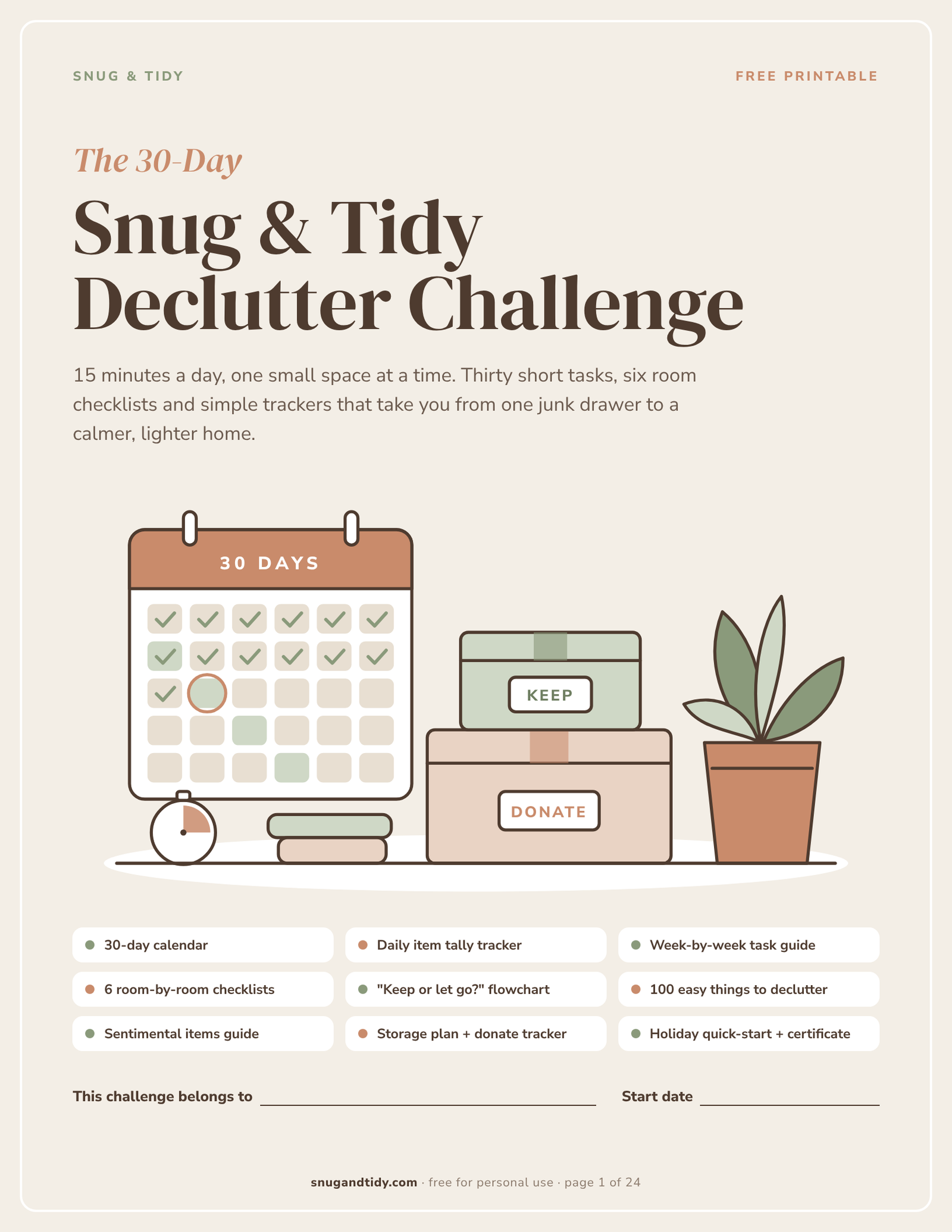
Free: the 30-Day Declutter Challenge
15 minutes a day, one small space at a time. Get the 24-page printable (calendar, room checklists, tracker) plus a short daily tip by email.
Get the free 30-Day Declutter Challenge
Home Reset System
If you want the whole home covered, not just decluttering, the Home Reset System is a 50-page fillable printable system with a timed room reset method, a six-question keep or let go decision path, a 6-box sort, a donate, sell and return tracker, weekly cleaning schedules and a 30-day kickoff. It comes as 4 PDFs (US Letter and A4, each in color and low-ink) that you can type into or print, and it is made for small homes, rentals and busy weeks.
Get the Home Reset SystemMore free pages live on the free printables page.
Keep or let go: six quick questions
When you stall on an item, run it through these in order. Two “no” answers usually means it can go.
- Have I used it in the last 12 months?
- Would I buy it again today?
- Does it work, fit and have all its parts?
- Do I have a better one that does the same job?
- Does it have a home, or does it live on a surface?
- Am I keeping it out of guilt or “just in case”?
Stuck on a “maybe”? Put it in a dated box, tape it shut and store it. If you have not opened it in three months, donate it without looking inside.
What to do with everything you let go
Most decluttering stalls at this step: the bags sit by the door for weeks. Decide where each category goes before you start.
| Item | Where it goes |
|---|---|
| Clothes, shoes, books, kitchenware in good shape | Donate, give to friends, or sell. Wash or wipe first. |
| Unused or expired medicines | FDA says a drug take-back option (drop-off or mail-back) is best. If none is available and the medicine is not on the FDA flush list, mix it (do not crush pills) with something unappealing like coffee grounds or cat litter, seal it in a plastic bag and put it in the trash. Scratch out personal info on the label. |
| Old phones, laptops, tablets | EPA advises deleting all personal information and removing batteries first, then using a certified electronics recycler, a retailer take-back program or your local program. |
| Lithium-ion batteries and devices that contain them | Not in household trash or recycling bins, per EPA. Take them to a battery recycling or household hazardous waste collection point. Tape the terminals or bag each one to prevent fires. |
| Tax records and paperwork | The IRS general rule is to keep records for 3 years after filing, with longer periods in some cases (for example 6 or 7 years). Shred anything with personal details. |
| Old cleaning products | Use them up or check your local household hazardous waste program. Never pour them together. |
| Broken, stained or worn-out items | Trash or recycle according to your local rules. |
Cross-cut paper shredder for home
A small shredder makes the paperwork session fast and keeps personal details out of the recycling. Look for cross-cut or micro-cut (more secure than strip-cut), a sheet capacity of 8 or more, a basket that fits under a desk, and auto start and stop.
Shop on AmazonPortable file box with hanging folders
Once paperwork is down to what you need, one file box keeps it together. Look for a lid that latches or locks, a carry handle, letter-size hanging folders included, and a size that fits a closet shelf.
Shop on AmazonSmall-space and renter tips
- Declutter before you buy storage. Measure the shelf, drawer or closet after you finish, then buy containers to fit what is left.
- Use vertical space you do not need to drill. Over-the-door organizers, freestanding shelves and stackable bins.
- Use the space under the bed. Low, lidded containers or zip bags hold off-season clothes and spare bedding.
- Keep a donate bag in the closet. Drop items in as you notice them.
- Renters: test adhesive hooks on a hidden spot first and follow the weight limit on the package.
Under-bed storage bags with zippers and handles
Under-bed bags hold off-season clothes and spare bedding in rooms with no spare closet. Measure the clearance under your bed first, then look for a height that fits, a clear window so you can see what is inside, sturdy handles and a full zipper.
Shop on AmazonAdjustable drawer dividers
Dividers stop a decluttered drawer from turning back into a junk drawer. Look for spring-loaded or expandable dividers that fit your drawer depth and width, with soft ends that will not scratch.
Shop on AmazonKeep the clutter from coming back
- One in, one out: a new mug means an old mug goes.
- A 10-minute evening reset: return everything that belongs elsewhere before bed.
- A monthly hot spot sweep: the entry table, kitchen counter and nightstand collect clutter first.
- A waiting list for purchases: write down non-essentials and wait 30 days.
- Pair decluttering with cleaning: a clear surface takes seconds to wipe.
Weekly Cleaning Schedule Printable: A 20-Minute-a-Day Plan
Winter Decor After Christmas: 20 Cozy Ideas
Quick-start checklist
Declutter checklist printable: your first week
- Set up four boxes: keep, donate or sell, trash or recycle, belongs elsewhere.
- Pick the easiest room first, usually the bathroom or entry.
- Set a 15 to 30 minute timer for each session.
- Work one zone at a time, top to bottom.
- Use the six questions on anything you stall on.
- Put “maybe” items in a dated, taped box.
- Take expired medicine to a take-back site.
- Bag lithium-ion batteries and take them to a collection point.
- Wipe data from old phones before recycling them.
- Shred old paperwork you no longer need.
- Take the donate box to the car the same day.
- Measure, then buy storage only for what is left.
FAQ
Where do I start decluttering my home?
Start with a small room that has few emotional items, like the bathroom or entry. Quick wins build momentum. Save the closet, paperwork and sentimental items for later, once making decisions feels easier.
How do I declutter my house fast?
Set a timer for 15 to 30 minutes, use four boxes (keep, donate or sell, trash or recycle, belongs elsewhere) and start with obvious trash and duplicates. Do not organize while you declutter, and take the donate box out the same day.
How do you declutter when you feel overwhelmed?
Shrink the job. Pick one drawer or one shelf, set a 15-minute timer and stop when it rings. Start with easy categories like expired food, empty bottles and junk mail, and follow a day-by-day plan such as a 30-day declutter challenge.
What is the 12-12-12 decluttering challenge?
It is a quick sorting game: find 12 things to throw away, 12 things to donate and 12 things to return to their proper place. It works well as a 20 to 30 minute session when you do not have time for a full room.
How long should you keep paperwork?
For tax records, the IRS general rule is 3 years from when you filed, with longer periods in some situations, such as 6 years if income was underreported or 7 years for certain loss claims. Shred anything with personal information when you let it go.
What should I declutter before moving?
Start with bulky, low-value items: books, kitchen extras, clothes that do not fit, old electronics and storage boxes you have not opened. Use the room-by-room checklist at least four weeks before the move so donations and sales are done before packing.
Sources: US FDA: Disposal of Unused Medicines; US EPA: Used Lithium-Ion Batteries; US EPA: Electronics Donation and Recycling; IRS: How long should I keep records?; Louisiana Department of Health: Don’t Mix Bleach With Other Household Cleaners.
About Snug & Tidy: we share cozy decor, simple organizing and seasonal ideas for real homes on a real budget. Product suggestions are chosen for fit and value, and some links are affiliate links (disclosures). Prices and availability change, so check the retailer before you buy.